
Compound interest has a branding problem. It’s supposed to be the closest thing personal finance has to magic, and yet the first few years of actually doing it feel like nothing much is happening. That’s not a sign it isn’t working — it’s just what the early part of the curve looks like.
Why the first years feel like nothing
Interest on interest is real from day one, but in the early years the “interest” part of that phrase is tiny, because there isn’t much balance yet to earn it on. Put $200 a month into an account earning 7% a year, and after twelve months you’ve contributed $2,400 and the account holds about $2,486 — roughly $86 that came from growth rather than your own deposits. It’s easy to look at that and conclude the growth isn’t doing much. For a while, it genuinely isn’t doing much, in absolute terms.
Where the curve actually bends
What changes isn’t the rate — it’s the base the rate is acting on. Every year, more of the balance is prior growth rather than fresh contributions, and growth earning growth is what compounding actually means. The same $200 a month, at the same 7%, looks completely different by year 30:
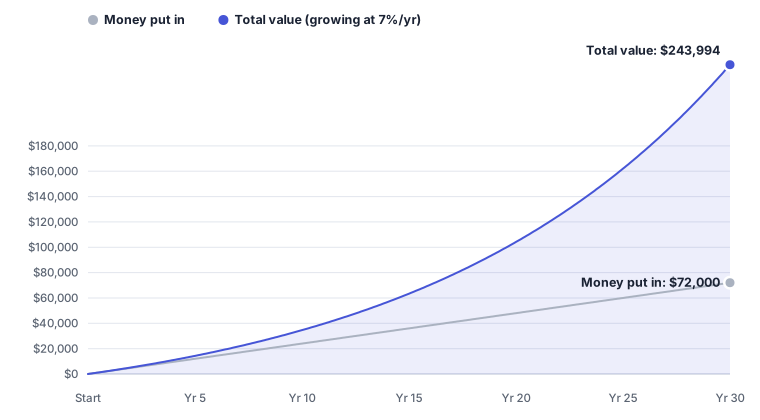 Same $200/month, same 7% return — the gap between what you put in and what it’s worth barely shows for a decade, then does most of its work in the last one.
$72,000 went in over those 30 years. The account is worth $243,994. Almost none of that $172,000 gap opened up early — most of it appears in the back half of the chart, because that’s when the growing balance finally has enough size for its own growth to matter more than new contributions do.
What this means for a decision today
The practical takeaway isn’t “save more” — it’s “start now instead of waiting for a better moment,” because the years at the beginning are the ones that end up mattering most, even though they’re the years that feel least rewarding. Waiting five years to start doesn’t just cost you five years of contributions; it costs you five years at the base of the curve, which is exactly the part later growth depends on.
None of that works, though, if the monthly contribution isn’t actually sustainable — if it’s the first thing that gets skipped the moment a bill lands wrong. That’s a cash flow problem, not an investing one: knowing whether $200 a month is actually there every month, or just there on average. Tally forecasts your balance forward against your real bills, so a recurring contribution is something you can commit to with confidence instead of something you hope fits.