
Most budgeting and forecasting advice quietly assumes a paycheck: the same amount, landing on the same schedule, every one or two weeks. Freelancers, contractors, and anyone with commission or project-based income don’t have that. A client pays net-30, another pays whenever they get around to it, and a good month can be double a slow one. Tools built around a steady paycheck break immediately.
Why fixed budgets fail with variable income
Zero-based budgeting and most category-based apps ask you to plan against a known amount coming in. With irregular income, that number isn’t known — it’s a guess, and a bad one skews every category under it. The real risk isn’t overspending in any one category; it’s a gap between when an invoice is owed and when it actually lands, and that gap is exactly what a cash flow forecast is built to handle, because it works off timing instead of a fixed plan.
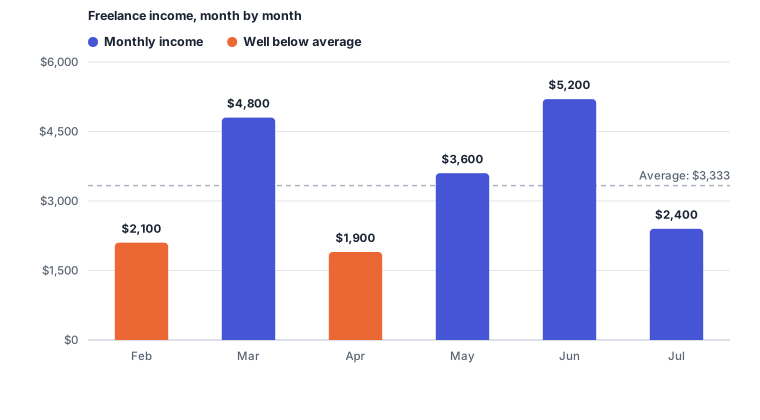 The average is a fine planning number. It’s not what actually lands in any given month.
What a forecast needs to do differently
Forecasting for irregular income has to account for a few things a standard forecast can skip:
- Income as a range, not a fixed number — using a recent average or a conservative estimate instead of assuming the biggest month repeats.
- Payment lag — the gap between finishing work and actually getting paid, which for net-30 or net-60 clients can be a month or more.
- A larger buffer — with less predictable timing on the income side, the forecast needs more cushion between the projected low point and zero.
- Every recurring bill tracked in one place, since the expense side is usually the one fixed, predictable half of the equation.
Turning irregular income into a plannable forecast
None of this makes irregular income predictable, but it makes it plannable — instead of hoping a payment lands before rent is due, you can see the specific week where the gap is tightest and plan around it in advance.
Tally handles this the same way it handles any income: keeping your recurring bills tracked and projecting your balance forward based on when money actually moves, not when it’s scheduled to on paper — which matters even more when the paycheck itself isn’t on a fixed schedule.